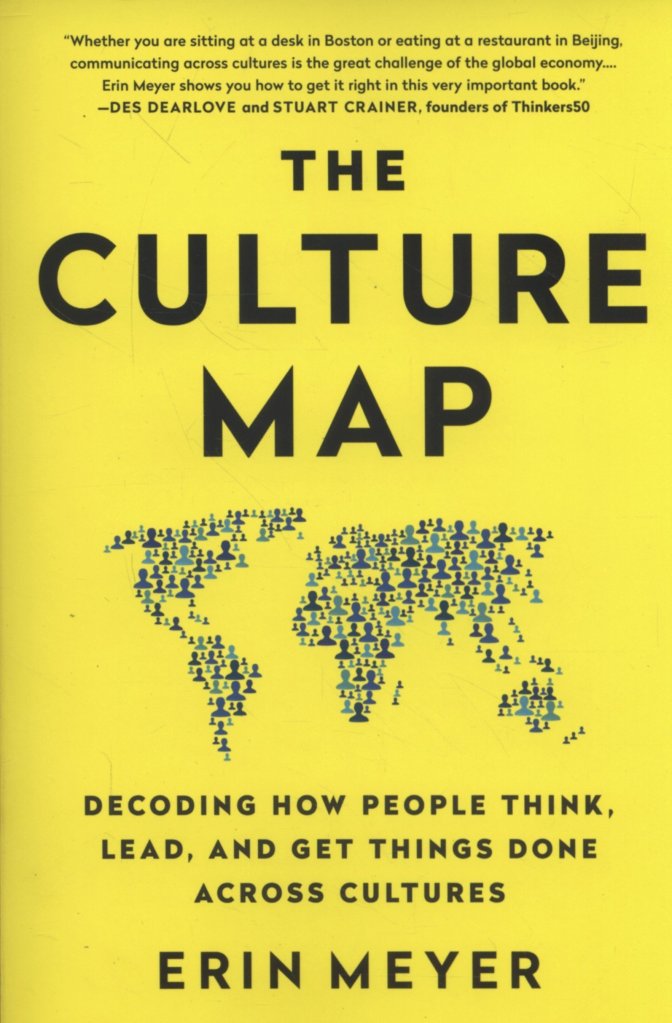
Erin Meyer is a Minnesota-born management scholar currently working as a faculty at INSEAD, France. Her work focuses on cross-culture communication in business. I find her book, The Culture Map: Breaking through the Invisible Boundaries, educating as it portraits and compares business cultures in the U.S. and other countries. As a China-born academic working in the U.S., I desperately needed a map to help me understand the culture in my workplace as well as other organizations in the U.S. And this book turns out to be exactly what I needed.
The book starts by outlining seven key aspects of business culture, including 1) giving negative feedback 2) organizational decision making 3) faces of friendliness 4) relational or task-based trust 5) reasons first or applications first 6) expressing disagreement 7) punctuality. Each aspect is discussed in a chapter with vivid examples and theoretical arguments. While I find all chapters informative and a joy to read, chapters on topics 1-3 strike me the most. Having lived in the U.S. for six years, I have to say that I was not fully aware of these three things until Erin points them out to me directly in this book.
1) Giving negative feedback
Americans tend to sugarcoat negative feedback and use the “3+1” technique (three positive comments preceding every negative comment). While Americans are generally straightforward in expressing opinions, giving negative feedback is one exception. That is when Americans become very diplomatic. Usage of strong positive words (e.g., “great”, “excellent”, “terrific”) in positive feedback and plenty of softening words and phrases (e.g., “this is just my opinion, it may or may not matter”, “seems”, “a bit”) in negative feedback is common. I recall the Malaysia-born actress Michelle Yeoh once said in an interview that Hollywood directors often said things like “That’s great. Let’s try it again!” and it made her wonder that “if you really think it’s great, why should we do that again?” In contrast, the Taiwan-born director Ang Lee always said what he meant. Understanding this cultural difference can help one decipher the real message behind a piece of feedback and get to others’ true opinions.
2) Organizational decision making
It’s interesting that organizations with a flat structure and seemingly egalitarian culture are not always characterized with egalitarian decision making. That is the case with American organizations. Compared with their European and Asian counterparts, American businesses have a flatter structure and people appear to be more equal (e.g., many people call their bosses by their first names). But decision making in American organizations are often top down. In other words, it’s the boss’ call. Erin believes that is because quick action and agility are hard coded in America’s business DNA. People value speed, and consensus building is time consuming. A decision can be quickly made and changed often. Therefore, accompanying this top-down process is flexibility. In contrast, in some countries (e.g., Germany, Japan), organizations appear to be more hierarchical, yet people spend a significant amount of time building consensus. I find this “misalignment” between organizational structure and decision structure quite interesting.
3) Faces of friendliness
Erin divides cultures into two types: “peaches” and “coconuts”. The main difference between a peach and a coconut is where the hard part of the fruit is. A peach is soft in the outside and hard in the inside, whereas a coconut is the opposite. These fruits are used as analogies of different approaches to friendliness. In a peach culture (e.g. America), people can easily be friendly with strangers, but their emotional intimacy are protected by an inner core. In contrast, in a coconut culture (e.g. France, China), people appear much less friendly on the outside, but once you break the shell, you find them quite open. Both fruits have one lesson to teach: do not judge friendliness at first sight!
Aside from those chapters, the rest of the book is also great. As a foreigner living in America, my attention is largely drawn to discussions on the American business culture. But as the title of the book suggests, the book goes far beyond that. It discusses cultures in Scandinavian countries, Latin American countries, the Netherlands, the UK, Germany, France, India, China, Japan… Moreover, the different cultures are mapped along each dimension discussed in the book so that readers can tell the cultural distances between those countries. The writing is concise and attention-grabbing. I recommend this book to everyone who is interested or already engaged in cross-culture communication.
 Jing Deng