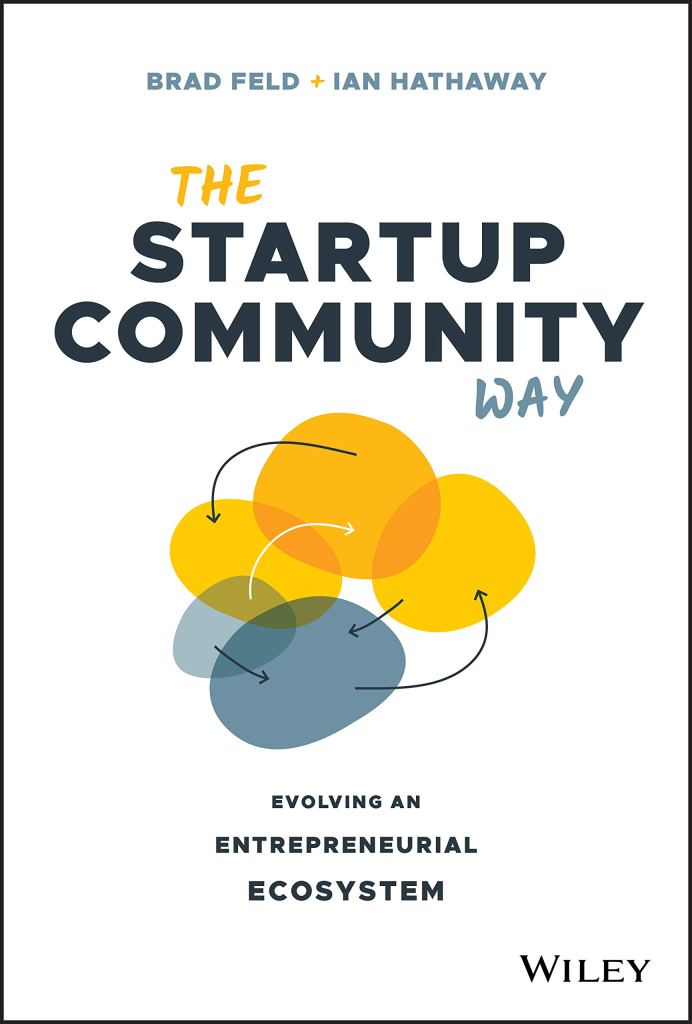
I discovered this book when I was checking out the website of the Blackstone Entrepreneurs Network to look for someone to interview for my new research project. I discovered Brad on the website, Googled him, and found out about this newly published book he co-wrote with Ian. It turned out to be a great read.
Both brad and Ian are practitioners who have spent years building and thinking about startup communities. What makes the book exciting at first sight is its using Boulder – the city I live in and love – as a prototype. Brad has lived in Boulder for over twenty years. He has not only witnessed how the Boulder startup community grew but also been an active force that shaped it (Ian has been researching startup communities for years while also participating in entrepreneurship practice; the duo was introduced to each other by Richard Florida.)
But the most interesting thing about the book is the way the authors see startup communities as complex systems and their recommendations based on that. Startup communities are complex systems because there are many actors (entrepreneurs, VCs, workers, policy makers, educators, college graduates, cultural leaders, social leaders, residents, etc.) and factors (people, technology, money, institutions, economy, policy, history, culture, environment, exogenous shocks, etc.). These actors and factors interact with one another in complex ways, and their aggregate influence on the system is nonlinear. Brad and Ian point out that complex systems have the following characteristics:
1. They cannot be controlled. The relationships between the parts of the system and their aggregate influence are nonlinear. There is thus inherent uncertainty in the outcome of complex systems. In the case of startup communities, that means you cannot create a startup community by merely investing in local startups or encouraging young people to jump start startups; nor can you know for sure that improving labor policies will increase local talent pool by x percent. Trying to design the system from top-down often does not work. The way complex systems evolve is often a bottom-up process.
2. They cannot be fully understood. The causal relationships are complex, non-linear, and fuzzy. Modeling the system and making predictions are difficult.
3. The interactions between parts of the system is more important than the parts. Systems improve by changing the connections, not the parts. This is an important overarching philosophy of the book. How different actors interact with one another is more important than tangible and measurable parts of the system. Contagion or the spreading of ideas, mentalities, and behaviors can happen.
4. Progress is uneven, slow, and surprising. Complex systems evolve slowly; often times no change happens immediately. However, once the system arrives at a tipping point, things may change drastically. The cumulative effect of small actions can lead to big change.
5. There is simplicity in the complexity. Although at the aggregate level the system is complex, at the micro-level each individual may be following a simple rule (e.g. be giving and helping to others).
6. They can be guided and influenced. One needs to embrace uncertainty and experimentation when trying to influence or guide complex systems.
Based on those characteristics, the authors put forward several actionable suggestions for building startup communities:
1. Give up the illusion of control. Get comfortable with uncertainty. Trust the process. Trust emergence.
2. Embrace experimentation. Experimentation is fundamental to entrepreneurship. It is also fundamental to the creation of startup communities. Keep running small scale experimentation—many will fail, but some will work.
3. Leadership is key. Entrepreneurs must lead the process and do it proactively. Other actors are feeders who can contribute to the process.
4. Take action. Do little things. Little things make big things happen. Don’t wait or ask for permission.
5. Give first.
6. Make long-term commitment. Commit at least 20 years to build a startup community. Think in generations.
Clearly, Brad and Ian value intangible, mental qualities of startup communities much more than tangible qualities. They have a cool iceberg model (p.217) and a cool lever model (p.222). The models show their rankings of relative importance of different qualities of startup communities. The iceberg model posits that activities < trends < structure/behavior < worldview/mentality ( “<” means is shallower/less substantial than). Similarly, the lever model posits that the conscious lever (culture, mindset, attitudes, values, worldview) is the most powerful lever, followed by the social lever (rules, norms, incentives, goals, structures), the information lever (information flows, data, feedback, connectivity), and the physical lever (tangible assets and resources, infrastructure). And the most important thing—mentality—is about what assumptions, values, and beliefs one holds. Whether or not one is willing to give, to share with others, and to believe that it is a positive sum game and together people can make a difference can shape norms, institutions, structure, behavior, and trends tremendously.
I think the major contribution of the book is offering a complexity system perspective for understanding startup communities. And the recommendations are actionable. Overall, a highly readable book by hands-on practitioners. I would recommend this book to people looking for insights from practitioners on how to startup communities.
 Jing Deng